




.png)


Top 7 Design Agencies for Prediction Markets in 2026
Top 7 Design Agencies for Prediction Markets in 2026
Prediction markets have become one of the most demanding UX/UI design challenges in digital product today. Monthly trading volume across the sector surged from roughly $1.2 billion in early 2025 to over $20 billion by January 2026, and platforms like Polymarket and Kalshi now process billions in monthly volume. But the design problems these platforms face are not typical fintech problems — they sit at a unique intersection of real-time data visualisation, behavioural finance, blockchain interaction patterns, regulatory compliance, and trust architecture that very few design teams have meaningful experience navigating.
A prediction market is a platform where users buy and sell contracts based on the outcome of future events, with contract prices reflecting collective probability estimates. The interface must communicate shifting financial data clearly, present resolution criteria transparently, guide users through wallet and identity flows without friction, and maintain trust in high-stakes environments where real money is at risk on every interaction.
This article profiles seven design agencies with relevant capabilities for prediction market work, examines the design patterns that define the three leading platforms, and provides a framework for evaluating design partners in this space. It is written for product leaders and design-minded founders building new or upgraded prediction market platforms in 2026.
Design Patterns from the Top 3 Prediction Market Platforms
Before evaluating agencies, it is worth understanding the design patterns that define the most successful prediction market products in 2026. Polymarket, Kalshi, and Robinhood each take a fundamentally different approach to the same core problem: making probabilistic thinking accessible, trustworthy, and actionable. The design decisions each platform has made — and the tradeoffs those decisions produce — should inform how you evaluate any agency's ability to work in this space.
Polymarket — Consumer-First, Crypto-Invisible
Polymarket is built on the Polygon blockchain but its design philosophy is to make that fact invisible. The interface is clean, modern, and deliberately closer to a social media feed than a trading terminal. Market pages display the current price, a probability chart, the order book, and resolution criteria in a hierarchy that prioritises comprehension over data density.
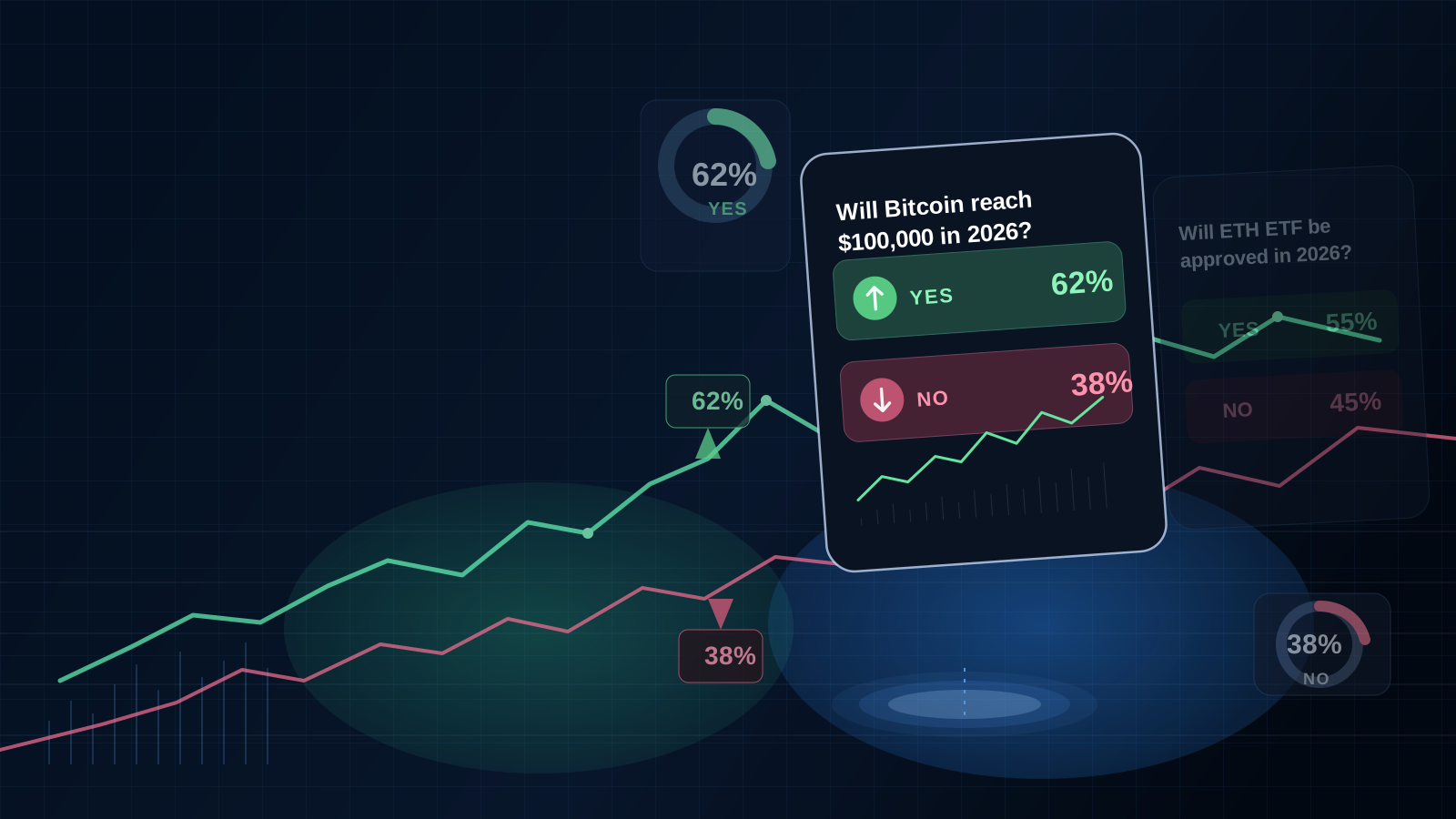
The key design pattern that defines Polymarket's success is the market card as primary navigation unit. Each event is presented as an interactive card with a clear binary or multi-outcome structure, colour-coded indicators, and a prominent probability number. This card-based pattern makes market discovery feel like browsing rather than trading, which is critical for onboarding non-crypto-native users. During the 2024 US election, this approach helped Polymarket's mobile app reach the top spot in App Store rankings — competing directly with news apps like the New York Times and CNN rather than trading apps.
Polymarket's onboarding flow uses embedded wallets and account abstraction to eliminate seed phrase management entirely. The design goal is to move a user from landing page to first trade with minimal steps, abstracting away gas fees, wallet setup, and blockchain transaction mechanics. This is the defining example of what the industry now calls "invisible Web3" — where the crypto infrastructure powering the product is entirely hidden from the end user.
Their real-time data visualisation favours clarity over density. Probability timeline charts use clean line graphs with colour-coded outcome indicators rather than the candlestick patterns familiar to financial traders. Polymarket treats its users as information consumers first, traders second.
The design tradeoff is depth. Power users and active traders often find the interface lacking in order book visibility, position management tools, and multi-market portfolio views. The platform does not surface full contract volume data or granular depth charts. Its strength is accessibility, and that comes at the cost of the information density that professional traders expect.
Kalshi — Exchange-Grade, Regulation-Visible
Kalshi takes the opposite approach. Its interface looks and feels like a traditional financial exchange — organised market categories, clearly presented contract details, and a professional aesthetic that signals institutional credibility.
The onboarding pattern is deliberately conventional: sign up, verify identity through KYC, deposit funds via bank transfer or debit card. For users familiar with opening a brokerage account, this feels natural and trustworthy. Critically, the design makes the regulatory framework visible rather than hiding it. CFTC designation is a core part of Kalshi's value proposition, and every friction point in the identity verification flow serves a dual purpose: legal compliance and trust signalling. This is an important design lesson — in regulated financial products, compliance friction can actually build trust rather than erode it, if the design communicates why it exists.
Kalshi's market browsing is category-driven rather than feed-driven. Markets are organised taxonomically — politics, economics, sports, technology, weather, climate, crypto — with contract details including settlement rules, expiry dates, and fee calculations presented prominently. The information architecture assumes users arrive with intent to trade in a specific domain rather than to browse and discover.
The trading interface prioritises data density. Order books, depth charts, and contract specifications are accessible without drilling down through multiple views. Kalshi offers what reviewers describe as unmatched granularity — from Federal Reserve meeting outcomes to local gas price predictions — with each market providing the kind of contract-level detail that mid-frequency and institutional traders need to assess liquidity and execution quality.
The design tradeoff is the learning curve. The KYC process is a speed bump for users who want instant access, and the exchange-like aesthetic can feel intimidating to casual participants. Kalshi's mobile experience is responsive but desktop-first in its information hierarchy, which reflects its positioning toward serious participants.
Robinhood — The Embedded Prediction Experience
Robinhood's prediction markets represent a third design paradigm: prediction trading embedded within a broader financial super-app. Rather than building a standalone prediction market product, Robinhood integrates event contracts directly into its existing investing interface, sitting alongside stocks, crypto, and ETFs.
The design philosophy here is radical simplification. Robinhood's prediction markets interface strips away the complexity visible in both Polymarket and Kalshi — there is no order book displayed, no depth charts, no contract volume data. Instead, contracts are presented in a clean, digestible format that mirrors the simplicity of buying a stock: pick an event, choose Yes or No, see the price (which represents the market's implied probability), and trade. A contract priced at $0.75 means the market thinks there is a 75% chance the event will happen. If you are right, you receive $1.
This simplification is a deliberate design decision rooted in Robinhood's core insight: prediction markets can attract a far larger audience if they feel like an extension of investing rather than a separate, complex activity. The interface uses the same minimalist dark-background aesthetic, the same navigation patterns, and the same account infrastructure as the rest of the app. Users do not need to download a separate app, create a new account, or learn a new interface. Sports events, economic indicators, politics, crypto prices, climate data, and entertainment outcomes are all browsable through a horizontal category scroll that feels native to the Robinhood experience.
The mobile-first approach is a particular design strength. Robinhood's prediction markets operate primarily through the app, and the interface is optimised for touch interaction — large tap targets, simple binary choices, real-time price updates with animated probability counters, and push notifications for market-moving events. The app supports biometric login and toggleable dark/light modes, maintaining the security and accessibility patterns users expect from a financial product.
Where Robinhood's design approach is most instructive for new platform designers is in how it handles the onboarding-to-first-trade flow. Because prediction markets sit inside an existing brokerage account, the KYC process is already complete for most users. Funding happens through existing bank connections. The result is that a user can go from discovering prediction markets to placing their first trade in under a minute — a conversion funnel that neither Polymarket nor Kalshi can match for their existing user bases.
The design tradeoff is significant, though. Robinhood deliberately hides trading infrastructure that sophisticated users want: there is no visibility on bid-ask spreads in the order book, no contract volume indicators, and no way to assess market depth before placing a trade. For users who want to understand the mechanics of the market rather than simply participate in it, the interface provides too little information. The simplicity that makes it accessible to millions also makes it unsuitable for users who treat prediction markets as a serious analytical tool.
Design Lessons for New Platforms
Each platform reveals a fundamental design tension that new prediction market products must resolve:
Polymarket demonstrates that crypto complexity can be fully abstracted through embedded wallets and invisible blockchain infrastructure — but at the cost of advanced trading features. Kalshi proves that making regulation visible is itself a trust pattern, not just a compliance burden. Robinhood shows that embedding prediction markets into a familiar financial interface dramatically lowers the barrier to entry — but at the cost of the depth and transparency that define the category.
The most effective new platforms in 2026 will need to selectively borrow from all three: Polymarket's frictionless onboarding and market discovery patterns, Kalshi's trust-through-transparency and institutional-grade data presentation, and Robinhood's embedded experience design and radical simplification of the first-trade funnel.
1. Avark
Location: Manchester, UK | Founded: 2020 | Products shipped: 100+ | Website: avark.agency
Avark is a Web3-native design studio that has shipped over 100 blockchain products since 2020, spanning DeFi, NFTs, SocialFi, Web3 gaming, AI agents, and fintech. Founded by Ian Cox, Mike Strand, and Dan Heywood, the studio operates as a consultancy-led practice — scoping, designing, and in some cases building production-ready products for crypto-native teams.
Their relevance to prediction markets is rooted in pattern density. The specific design challenges of this space — wallet connection flows, smart contract interaction states, tokenomics visualisation, compliance-integrated onboarding, real-time data dashboards, and trust signalling in high-stakes financial environments — are problems Avark encounters across virtually every engagement. Their portfolio includes projects like Linea (gamified reward mechanics for Consensys), finestt (DeFi wallet simplification), Transak (crypto on-ramp infrastructure with compliance-conversion tension), Metacade (community-driven SocialFi), and Beyond (digital asset bridging interfaces). Each of these maps to a core prediction market design challenge.
Their consultancy-led approach means engagements typically start with strategic scoping and assumption validation before moving into production design — a process well suited to prediction market projects where information architecture decisions (how markets are categorised, how probability is communicated, how resolution criteria are surfaced) cascade through the entire product experience.
Worth noting: Avark's blockchain UX design guide is a useful reference for how they think about the interaction design problems specific to on-chain products.
2. Marqade
Focus: Web3 marketing design and tokenomics visualisation
Marqade has built a reputation for marketing-led design work in the Web3 space, with particular depth in tokenomics dashboard design and IDO (initial DEX offering) launch experiences. Their relevance to prediction markets sits in a specific niche: visualising complex token economics and incentive structures in ways that drive user participation.
Tokenomics visualisation — the design of tools and UI elements that present token flows, incentive structures, or probability distributions in interactive formats — is an underserved design specialty. Most design agencies treat tokenomics as a data table problem, but Marqade approaches it as an interaction design challenge, creating visual systems where users can explore how incentive mechanisms work through direct manipulation rather than passive reading.
For prediction market projects with native token incentives, staking-based participation, or liquidity mining components, Marqade's experience mapping multi-step token flows into scannable, interactive UI patterns is relevant. Their mobile-first approach to real-time updating dashboards also addresses the growing reality that prediction market trading increasingly happens on phones.
The design tradeoff with Marqade is scope. Their strength is marketing-integrated design where brand, UX, and go-to-market strategy are tightly coupled. For teams that need deep, standalone product UX work — information architecture, complex state management, multi-view trading interfaces — the fit may be narrower.
3. Northbeam Design
Focus: Data analytics dashboards and predictive analytics interfaces Location: Toronto, Canada
Northbeam Design's core competency is in data-driven analytics dashboards, originally rooted in marketing mix modelling (MMM) and attribution analytics. The design patterns they have refined — high-density data displays, responsive chart systems, cross-platform analytics with real-time updating, and customisable reporting layers — translate directly to prediction market use cases.
Prediction markets are fundamentally data visualisation products. Users need to interpret probability curves, compare contract prices across events, track portfolio performance over time, and assess historical accuracy of markets. Northbeam's approach to information density — showing maximum relevant data without creating cognitive overload — addresses the same tension that Kalshi navigates between professional traders who want depth and casual users who want clarity.
Their experience with statistical prediction feeds and real-time cross-platform analytics is applicable to prediction platforms that position their data layer as a competitive differentiator, particularly B2B forecasting tools or enterprise prediction products where the analytics experience matters more than consumer-friendly simplicity.
4. Rockerbox Studio
Focus: Econometric modelling interfaces and compliance-ready design
Rockerbox Studio's relevant capability is in designing interfaces for econometric models and live event data — UIs that handle real-time data streams, surface model outputs clearly, and integrate compliance controls without destroying the user experience.
The compliance design challenge is particularly relevant for prediction markets. Platforms operating in regulated jurisdictions need interfaces that incorporate risk warnings, jurisdictional gating, geo-restriction messaging, and regulatory disclosures in contextually appropriate ways. The UX problem is that every compliance element adds friction, and poorly designed compliance UX — intrusive modals, confusing legal language, unnecessary confirmation steps — kills conversion rates. Kalshi's success in making regulation visible as a trust signal rather than a burden is a benchmark here, and Rockerbox's experience balancing data-rich interfaces with regulatory requirements makes them worth evaluating for projects where compliance design is a primary concern.
Their technical design strengths include low-latency interface patterns and large-dataset rendering — important for platforms expecting high-volume trading during peak events like elections or major sporting outcomes, where dashboard responsiveness directly affects user trust.
5. Improvado Creative
Focus: Self-serve analytics platform design and embedded data visualisation
Improvado Creative specialises in self-serve analytics interfaces — designs that empower end-users to create, configure, and run custom data visualisations without developer intervention. This design pattern is increasingly relevant to prediction markets as they mature beyond simple trading into analytics-driven platforms.
Self-serve analytics refers to interfaces and tools that let users build custom views, filter data, and generate reports without needing a developer to configure each visualisation. The design challenge is progressive disclosure: how do you surface powerful tools without overwhelming casual users?
Improvado's approach — layered interfaces with sensible defaults, contextual tool exposure, and embeddable dashboard modules — maps to prediction market features like custom watchlists, historical accuracy analysis, sector-specific filtering, and portfolio analytics tools. As prediction markets attract more sophisticated users who want to analyse historical market accuracy, track their own calibration, and build custom views across market categories, the analytics layer becomes a meaningful differentiator.
6. Pulsar Platform Design
Focus: AI-powered sentiment analysis interfaces and real-time event dashboards Location: London, UK
Pulsar Platform Design specialises in designing interfaces that aggregate and visualise real-time social and market sentiment data. Their relevance to prediction markets is direct: platforms that combine sentiment-based data feeds alongside contract pricing give users a richer decision-making environment.
The design patterns Pulsar has developed for sentiment visualisation — colour-coded sentiment indicators, temporal sentiment overlays on event timelines, automated alert design for threshold shifts — are applicable to prediction market features like sentiment-informed odds presentation, social signal feeds alongside trading interfaces, and dynamic event dashboards that update as news breaks.
Their notification design experience is also relevant. Prediction markets are inherently time-sensitive, and notification UX — what alerts to surface, how to communicate urgency without creating noise, how to bring users back to the platform at the right moment — is a retention lever that many prediction market designs underinvest in. Robinhood's push notification system for market-moving events is a good benchmark for what users now expect.
7. MassTer UI Lab
Focus: Enterprise measurement tools and gamified engagement design Location: Austin, USA
MassTer UI Lab designs enterprise-grade, gamification-driven dashboards — interfaces that handle high transaction volumes while maintaining user engagement through game mechanics. The intersection of these two capabilities is precisely where prediction market UX lives.
Gamified prediction elements — leaderboards, achievement systems, badges, streak mechanics, progress indicators, and competitive ranking displays — are increasingly core to consumer prediction market retention. Polymarket and others have demonstrated that social and competitive features meaningfully increase repeat usage. But designing gamification for financial products is different from designing it for games: the mechanics must drive engagement without encouraging reckless behaviour, and they must sit alongside serious financial data without undermining trust.
MassTer's experience building these patterns into large-scale transactional interfaces — balancing the playfulness of gamification with the credibility that institutional and serious users expect — positions them for prediction market work that needs to serve both audiences simultaneously.
How to Choose the Right Design Agency for Your Prediction Market
The interface of a prediction market is not a cosmetic layer over backend logic — it is the trust layer. Users are depositing funds, interpreting probabilistic data, and making decisions with real monetary consequences. A poorly designed onboarding flow, an unclear contract resolution screen, or a confusing portfolio dashboard can destroy user confidence in ways that no backend fix can address.
Evaluating design domain expertise
Start by examining whether the agency has shipped products with analogous UX challenges. The specific design patterns that matter for prediction markets are: real-time data visualisation (not static dashboards — live updating interfaces where data changes second by second), wallet and transaction interaction flows (not just login screens — the full cycle of connect, sign, confirm, and handle errors), compliance-integrated onboarding (not bolted-on KYC — identity verification designed as part of the conversion funnel), and trust signalling through interface design (not just brand aesthetics — the structural trust patterns that communicate transparency, accuracy, and security).
Ask for case studies that demonstrate these specific capabilities. General Web3 branding work or marketing site design, however polished, does not prove an agency can handle the interaction design complexity of a trading interface.
Design and engineering coordination
Prediction market UX decisions are deeply coupled to technical constraints. Gas costs affect transaction UX. Oracle latency impacts dashboard update patterns. Wallet provider quirks create edge cases in connection flows. Blockchain confirmation times determine the feedback loops users see after placing a trade.
Agencies that design without understanding these constraints — or that hand off designs to engineering teams without close coordination — produce work that needs expensive rework. Evaluate whether the agency has experience designing within the technical constraints of blockchain products specifically, and whether their process includes regular design-engineering collaboration rather than a waterfall handoff.
Discovery and validation before production
The strongest prediction market design engagements start with structured discovery. Before committing to full UI production, a discovery sprint should validate core UX assumptions: how do target users understand probability? Which information hierarchy drives conversion — content-discovery like Polymarket's model, category-browsing like Kalshi's, or embedded simplicity like Robinhood's? Where do trust barriers exist in the onboarding flow? What level of data density do users expect?
Agencies that offer standalone consultancy or discovery engagements provide a structured entry point for this validation work, helping teams define scope and test assumptions before committing to a full design engagement.
Post-launch design iteration
The launch is the beginning, not the end. The best prediction market platforms iterate continuously — adjusting market creation flows, refining probability visualisation, optimising mobile trading experiences based on user behaviour data. An agency that delivers a pixel-perfect launch and disappears is less valuable than one that offers ongoing design optimisation through retainers or on-demand design sprints.
Key Design Patterns to Evaluate in a Prediction Market Design Partner
Beyond general design capability, specific pattern expertise separates agencies that can ship effective prediction market interfaces from those that will be learning on your project.
Probability communication design — The core UX challenge of prediction markets is that most users do not think probabilistically. The interface must bridge the gap between mathematical probability and intuitive understanding. This includes chart type selection (line graphs vs. candlesticks vs. distribution curves), colour coding for outcome sentiment, the use of natural language alongside numerical probability displays, and how much complexity to expose versus abstract. Robinhood reduces probability to a single cent-based price. Polymarket uses timeline charts. Kalshi provides full contract-level depth. How an agency navigates these tradeoffs reveals their depth of understanding.
Information architecture for real-time financial data — Prediction market interfaces must present live-updating data without creating visual noise or cognitive overload. The design system needs to account for streaming data patterns from the outset, including how price changes are animated, how new markets appear in discovery feeds, and how portfolio positions update as contract prices move.
KYC/AML onboarding UX — Know Your Customer (KYC) and Anti-Money Laundering (AML) verification flows are where compliance design most directly impacts conversion. The design challenge is tiered verification — light-touch identity checks for low-value participation, escalating to full document verification for higher limits — without breaking the onboarding flow. Robinhood sidesteps this for prediction markets by leveraging existing brokerage verification, but standalone platforms must solve it from scratch. Agencies with prior Web3 or fintech compliance design experience have a significant advantage here.
Mobile-first trading interaction design — Prediction market participation increasingly happens on mobile. Robinhood's app-only approach is the extreme end of this trend, but even Polymarket's mobile web experience drives a significant share of its user base. The trading experience needs to work on small screens, which means rethinking information hierarchy, designing for thumb-zone interaction, and ensuring time-sensitive actions are fast and error-resistant.
Wallet connection and transaction state management — For Web3-native platforms, the wallet connection, transaction signing, and settlement UX is where most user friction exists. The agency must understand wallet provider differences, gas estimation presentation, transaction confirmation patterns, pending state design, and error handling for failed or stuck blockchain transactions.
Trust and transparency patterns — Prediction markets require users to trust the platform with money and trust that outcomes will be resolved fairly. Kalshi makes its CFTC regulatory status visible as a trust signal. Polymarket relies on blockchain transparency and community verification. Robinhood inherits trust from its established brand and existing regulatory relationships. New platforms without these advantages need to build trust through interface design — visible resolution criteria, transparent settlement mechanics, clear audit trails, and prominent dispute resolution information.
Frequently Asked Questions
What services do prediction market design agencies typically offer?
Leading prediction market design agencies provide UX research and strategy, UI design for trading dashboards and market discovery interfaces, real-time data visualisation systems, Web3 wallet integration and smart contract interaction design, compliance-integrated onboarding flows, design systems and component libraries, brand identity, and post-launch design optimisation. The strongest agencies combine design strategy with deep understanding of blockchain interaction patterns rather than treating Web3 as a visual theme applied on top of standard fintech UX.
What should I prioritise when selecting a design partner for a prediction market?
Prioritise agencies with demonstrated experience designing real-time, data-rich interfaces within the constraints of blockchain or fintech products. Look for portfolios that include trading interfaces, wallet interaction flows, compliance-integrated onboarding, and gamified engagement systems — not just branding or marketing sites. The agency should understand the trust patterns that high-stakes financial interfaces require and have experience with the close design-engineering coordination that blockchain products demand. Post-launch design optimisation capability is also essential, as prediction market UX requires continuous iteration based on user behaviour data.
How does the design process for prediction market platforms usually work?
The process typically follows a structured sequence: discovery research including competitive UX analysis of leading platforms like Polymarket, Kalshi, and Robinhood; user flow mapping and information architecture definition; wireframing and low-fidelity prototyping of core trading, onboarding, and portfolio experiences; high-fidelity interface design with design system development; interactive prototyping and usability testing; design-engineering handoff or coordinated frontend development; and post-launch iteration. The best engagements front-load a structured discovery sprint to validate core UX assumptions before moving into production, which reduces rework and accelerates the path to launch.
What are the biggest UX challenges specific to prediction market design?
The core challenges are probability communication (making probabilistic data intuitive for users who do not naturally think in probabilities), the compliance-conversion tension (designing KYC/AML flows that satisfy regulators without killing onboarding conversion), real-time data density management (presenting live-updating financial data without cognitive overload), blockchain interaction abstraction (making wallet connections, transaction signing, and settlement feel seamless), and trust architecture (building interface patterns that communicate transparency, accuracy, and fairness). Each requires specific design expertise that generalist agencies typically lack.
How do the design approaches of Polymarket, Kalshi, and Robinhood differ?
Each platform represents a distinct design philosophy. Polymarket uses a consumer-first, card-based browsing interface that abstracts crypto complexity through embedded wallets — optimised for accessibility and market discovery at the cost of trading depth. Kalshi takes an exchange-grade approach with category-driven navigation, full order book visibility, and prominently surfaced regulatory credentials — optimised for trust and data density at the cost of onboarding simplicity. Robinhood embeds prediction markets into its existing brokerage app, radically simplifying the experience by hiding order books and contract volume data — optimised for conversion and familiarity at the cost of transparency and analytical depth. New platforms must decide where they sit on these spectrums based on their target audience.
Can a design agency help with regulatory compliance in prediction market interfaces?
Experienced agencies integrate regulatory compliance into the design process rather than treating it as an afterthought. This includes designing tiered KYC verification that balances conversion with legal requirements, jurisdictional gating based on user location, contextual risk warnings and regulatory disclosures, and audit-ready interface documentation. Agencies with Web3 and fintech experience bring established patterns for this work, while generalist agencies would need to develop compliance design expertise from scratch — a process that typically adds significant time and risk to a prediction market project.
Further Reading